
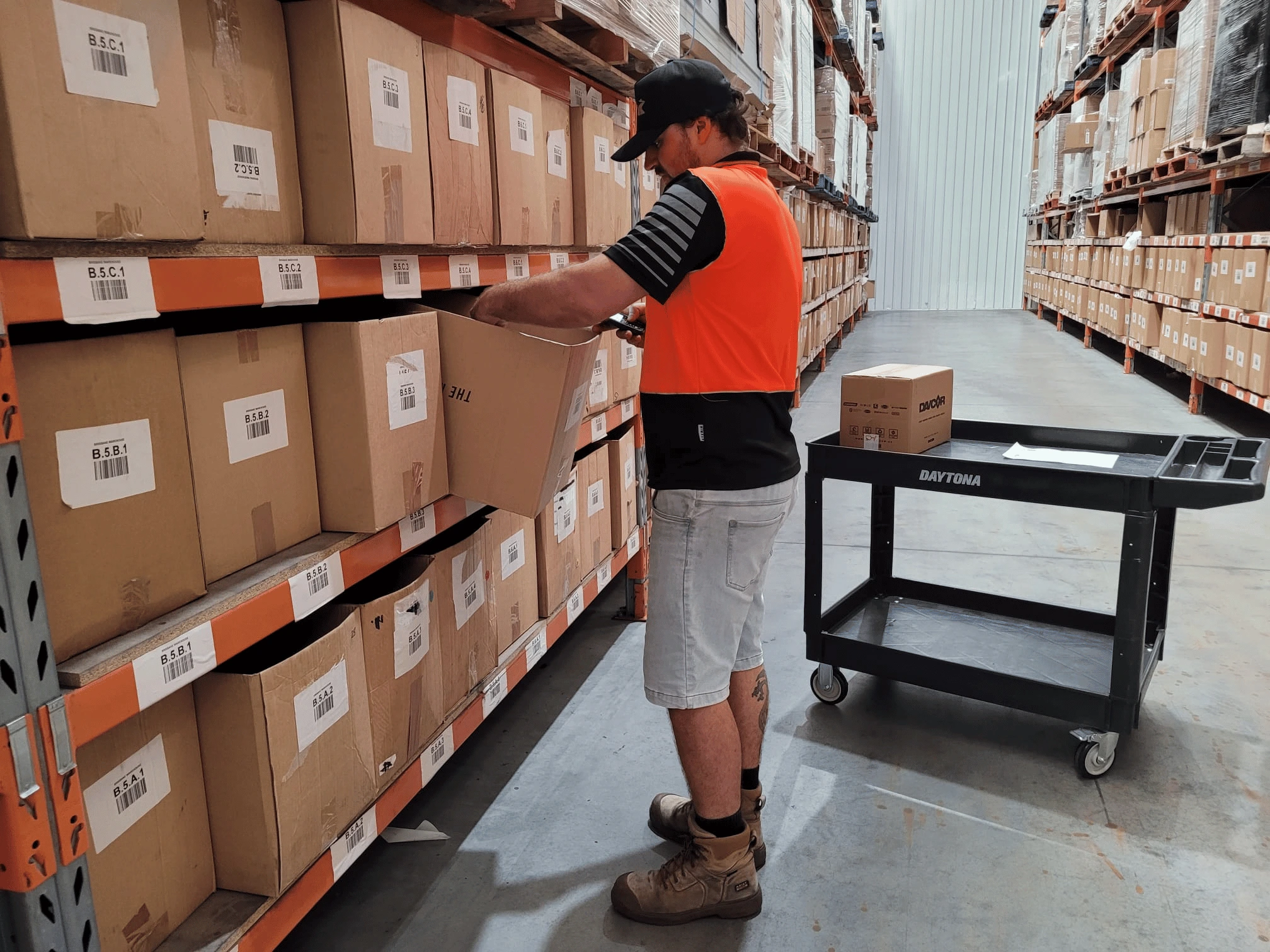
Every online order follows the same basic path: a customer buys something, the business picks the item, packs it, and sends it. At low volumes, this is straightforward. As order numbers grow, the process that felt simple at 20 orders a day becomes the bottleneck at 200 — and the errors, delays, and customer complaints that come with a stretched in-house operation can undo the growth the business worked hard to achieve.
This guide covers how ecommerce order fulfilment works, where the common problems arise, and when outsourcing becomes the more practical option.
How Ecommerce Order Fulfilment Works
The fulfilment process begins before the customer clicks buy. It starts with getting the right stock into the right location so it is ready to pick when an order arrives.
The standard fulfilment sequence is:
- Receiving: inbound stock is checked against the purchase order, recorded in the inventory system, and placed in a storage location
- Storage: products are held in organised, accessible positions — high-velocity items closer to the packing station
- Order receipt: when a customer places an order, the system generates a pick-list for the warehouse team
- Picking: warehouse staff collect the correct items from their storage locations and bring them to packing
- Packing: items are packed with the right protective materials, labelled with the customer’s address, and confirmed against the order
- Despatch: completed parcels are handed to the carrier at the scheduled collection time
- Tracking: the customer receives a tracking number and updates through to delivery
- Returns: the process in reverse — parcels come back, items are inspected, and stock is updated
Where Growing Businesses Run Into Problems
Pick Errors
Without a scan-and-verify step, picking errors are common in manual operations. A wrong item or wrong quantity in a parcel creates a return, a replacement shipment, and a customer service interaction — each costing more than the original order.
Missed Despatch Cut-offs
As order volume grows, the time available to pick, pack, and stage orders for carrier collection shrinks. Missing the daily cut-off means orders sit overnight and customers experience a one-day delay that did not appear in the stated delivery window.
Inventory inaccuracy
When inventory is managed on a spreadsheet or a basic system that does not update in real time, overselling happens — orders are accepted for stock that does not exist. The cost is a cancellation or a delay while stock is sourced.
Carrier limitations
Businesses using a single courier account have limited flexibility when a carrier has a service disruption, a pricing change, or a coverage gap. Australia Post’s 2023 Inside Australian Online Shopping report found that 76 per cent of consumers expect a choice of delivery options at checkout.
Businesses using a single courier account have limited flexibility when that carrier experiences a service disruption, pricing change or coverage gap. Australia Post’s 2026 eCommerce Report found that 69% of shoppers want a range of delivery options at checkout. Businesses selling across online and retail channels may benefit from integrated consumer and retail logistics that coordinate fulfilment, carrier allocation and distribution.
In-house Fulfilment vs Outsourced Fulfilment
The case for keeping fulfilment in-house is strongest when order volumes are low, products require very specific handling, or the business is still testing its market. The case for outsourcing is strongest when:
- Packing and despatch are consuming more than two hours of staff time daily
- Pick errors or late despatch are generating customer complaints
- Seasonal peaks create bottlenecks the team cannot absorb
- The business is expanding to new sales channels and needs one location to manage all inventory
Outsourcing fulfilment to a 3PL logistics converts fixed internal costs — staff, space, packaging materials, carrier management — into variable per-order fees that scale with volume.
What to Look for in a Fulfilment Partner
The key criteria are platform integration, despatch cut-off time, pick accuracy, inventory visibility, carrier relationships, returns handling, and the ability to scale. Review TLC Enterprise’s e-commerce fulfilment services to understand how these capabilities can support growing online businesses.
Is Order Fulfilment Limiting Your E-Commerce Growth?
TLC Enterprise provides scalable e-commerce fulfilment from Truganina, supporting online businesses with stock receiving, secure storage, inventory visibility, pick and pack, platform integrations, returns management and national distribution. Our team can review your current order volumes, sales channels, dispatch requirements and seasonal demand to determine whether outsourced fulfilment is right for your business.
Use the Free Transport Health Check-Up for a no-cost review of your current cold chain logistics setup, or contact bookings@tlcenterprise.com.au or 1300 343 751.
Frequently Asked Questions
Standard warehousing focuses on storing goods and moving them in bulk. Ecommerce fulfilment focuses on processing individual customer orders quickly and accurately. The technology, layout, and staffing model are different because the outcome is different.
At a professional fulfilment centre, an order received before the despatch cut-off is typically picked, packed, and handed to the carrier the same day. Transit time from there depends on the carrier and the delivery location — most metropolitan areas in Australia receive parcels within one to three business days.
This depends on the platform integration and inventory management setup. A well-configured WMS updates available inventory in real time and prevents orders from being accepted for stock that does not exist. Some businesses use a backorder system; others prefer to hide products when stock falls below a minimum threshold.
Yes. A 3PL with multi-channel WMS integrations can fulfil orders from a Shopify store, Amazon, eBay, and wholesale accounts from the same inventory pool. Each channel shows live stock levels, and the system allocates inventory correctly across all of them.