
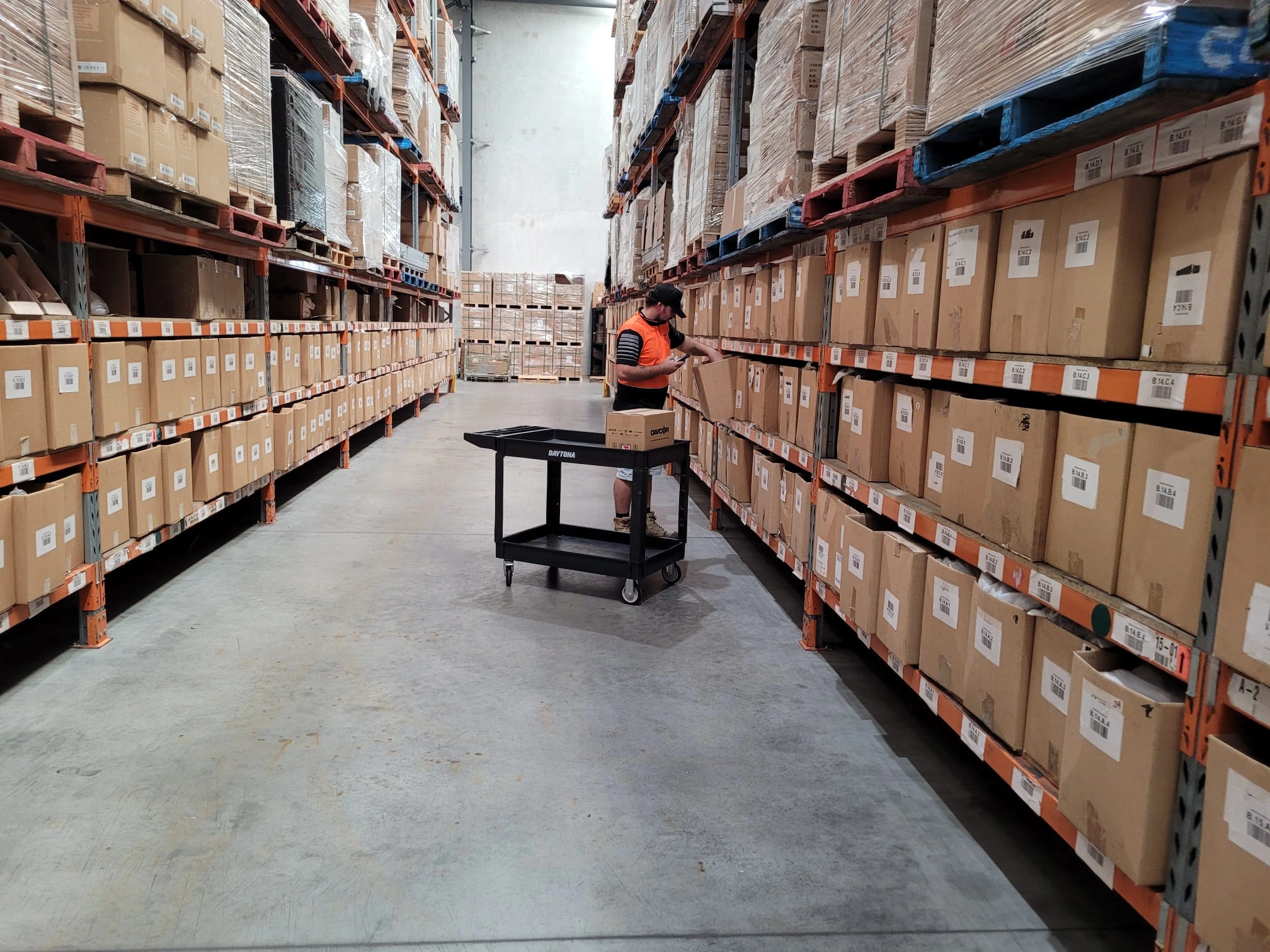
If you run an online store and orders are starting to pile up, you have probably heard the term fulfilment centre. It sounds straightforward, but businesses use it interchangeably with warehouse, distribution centre, and 3PL facility — and they are not the same thing. Knowing the difference saves time when you are deciding where to store stock and how to get orders out the door reliably.
What is a Fulfilment Centre?
A fulfilment centre is a facility that receives, stores, picks, packs, and despatches customer orders on behalf of a business. Unlike a standard warehouse, which stores goods over a longer term, a fulfilment centre is optimised for speed and accuracy at the order level. Every step — from the moment stock arrives to the moment a parcel reaches a carrier — is designed around processing high volumes of individual orders quickly.
The core functions of a fulfilment centre include:
- Receiving inbound stock from a supplier or manufacturer
- Storing products in organised, pick-accessible locations
- Picking and packing individual customer orders accurately
- Labelling and handing completed parcels to couriers or freight carriers
- Processing customer returns and updating inventory
Businesses that want to outsource these activities can use professional ecommerce fulfilment services to combine receiving, inventory management, picking, packing, returns and delivery coordination.
How a Fulfilment Centre Works in Practice
The process begins before stock arrives. A good fulfilment centre provider connects to a business’s ecommerce platform — Shopify, WooCommerce, or similar — so orders flow directly into the warehouse management system (WMS) without manual entry. Read TLC Enterprise’s guide to 3PL software integrations for ecommerce platforms for more information about order syncing, inventory updates and tracking data.
When an order is placed online, the WMS assigns it to a pick-run. A warehouse team member collects the items from their storage locations, confirms them with a barcode scan, and hands the completed order to the packing station. Packing staff apply the correct label and the parcel enters the despatch queue for carrier collection — often the same day if the order arrives before the cut-off time.
Australia Post’s 2023 Inside Australian Online Shopping report found that 62 per cent of Australian online shoppers rank delivery speed as a primary factor when choosing a retailer. A fulfilment centre designed around same-day or next-day despatch directly supports that expectation.
Fulfilment Centre vs Warehouse — The Key Distinction
A warehouse stores goods. A fulfilment centre moves orders. The physical space may look similar, but the layout, technology, and staffing are designed for different outcomes. Warehouse layouts prioritise dense storage. Fulfilment centre layouts prioritise fast picking — shorter walking distances between high-velocity product locations and the packing station.
If a business needs to hold a large volume of stock without frequent individual order dispatch, a professional warehouse service may be the better fit. If the goal is to get customer orders out quickly and accurately, a fulfilment centre is the correct tool.
For a more detailed comparison of storage, technology, order types and operating models, read Fulfilment Centre vs 3PL Warehouse.
When Does a Business Need a Fulfilment Centre?
A fulfilment centre makes practical sense when:
- Order volumes exceed what can be handled in-house without errors or delays
- Despatch cut-off times are being missed because packing takes too long
- Delivery delays are affecting customer reviews and repeat purchase rates
- The business is expanding into new sales channels and needs one place to manage all stock
- Seasonal peaks — Christmas, sales events, product launches — are creating fulfilment bottlenecks
For businesses that sell direct to consumers online and need fast, accurate order processing, outsourcing to a fulfilment centre removes the operational pressure from in-house teams and converts a fixed warehouse cost into a variable, per-order fee.
Is Your Business Ready for a Fulfilment Centre?
As ecommerce order volumes increase, managing stock, packing orders, meeting dispatch cut-offs and processing returns can place growing pressure on an internal team. TLC Enterprise provides scalable ecommerce fulfilment support, including stock receiving, secure storage, inventory visibility, pick-and-pack services, platform integrations and national distribution.
Use the Free Transport Health Check-Up for a no-cost review of your current cold chain logistics setup, or contact bookings@tlcenterprise.com.au or 1300 343 751.
Frequently Asked Questions
No. A warehouse is primarily used to store goods for longer periods. A fulfilment centre is designed to process individual customer orders quickly — receiving, picking, packing, and despatching. Some facilities combine both functions, but the operational priorities differ.
Most fulfilment centres integrate with major platforms including Shopify, WooCommerce, Magento, and marketplaces such as Amazon and eBay. Integration allows orders to flow into the fulfilment system automatically and tracking updates to return to the customer without manual input.
Stock is tracked through a warehouse management system using barcodes or RFID. Each product is assigned a storage location, and every movement — inbound receipt, pick, despatch, return — is recorded in real time. This gives the business an accurate, live view of available inventory.
Yes. Many fulfilment centres work with small and growing businesses and charge on a per-order or per-pallet basis rather than requiring a fixed warehouse lease. This allows a small business to access professional fulfilment infrastructure without committing to the cost of running a warehouse independently.